

Indiana lags the nation in 4-year college degree attainment. Just 36% of young Hoosier workers have a 4-year degree, compared to 42% in the nation. This puts Indiana in 37th place amongst states. Massachusetts holds a commanding lead, with 58% of 25- to 34-year-olds having a 4-year degree in 2024.
Many people correctly recognize that Indiana’s low college attainment threatens the state’s future economic prosperity. But too often, commentators converge on a common culprit: Brain drain. The story goes like this: Indiana has a decent education system and excellent universities. Our only problem is that our university graduates tend to leave the state after earning their degrees. Convincing more Hoosiers to attend college is futile, as they will just leave when they graduate.
How big is brain drain?
The brain drain fears aren’t entirely unfounded. College graduates1 do tend to be very mobile. Many students move to a different state to attend college, and many will move to a different state after graduation. And Indiana does see a net loss in these college-age migrations. But what I want to show here is that the magnitude of Indiana’s brain drain is small. It is far from being the most important factor in determining the state’s college attainment rate.
Below is a simple measure of brain gain and drain by state. The measure uses a person’s birth state and current state of residence to measure the change in college attainment that results from all prior net migration2. Indiana starts and ends with the lowest 4-year degree attainment rate of all states in the Midwest region. And it is not alone in experiencing brain drain. Every Midwest state other than Illinois loses college attainment via migration.
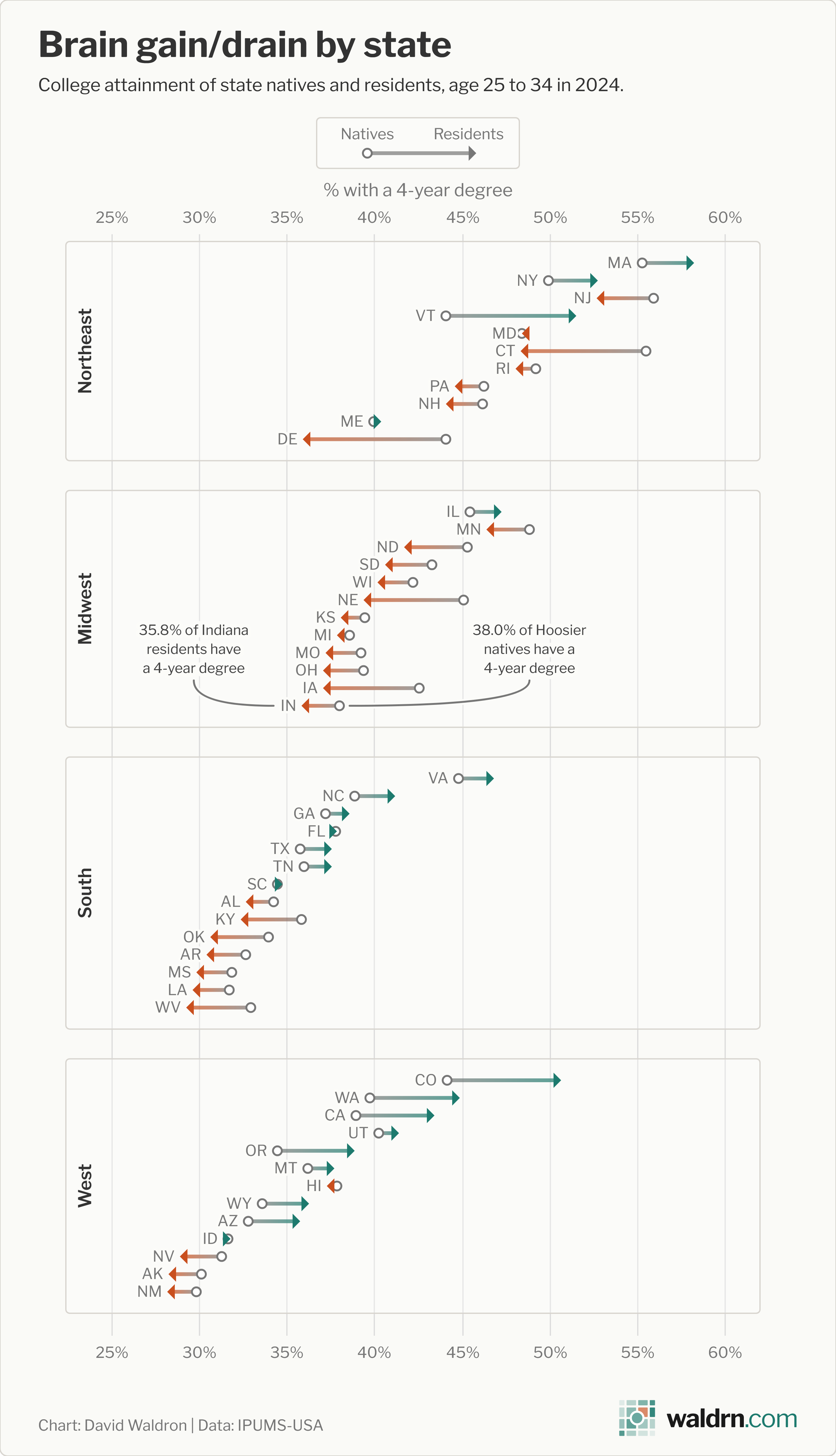
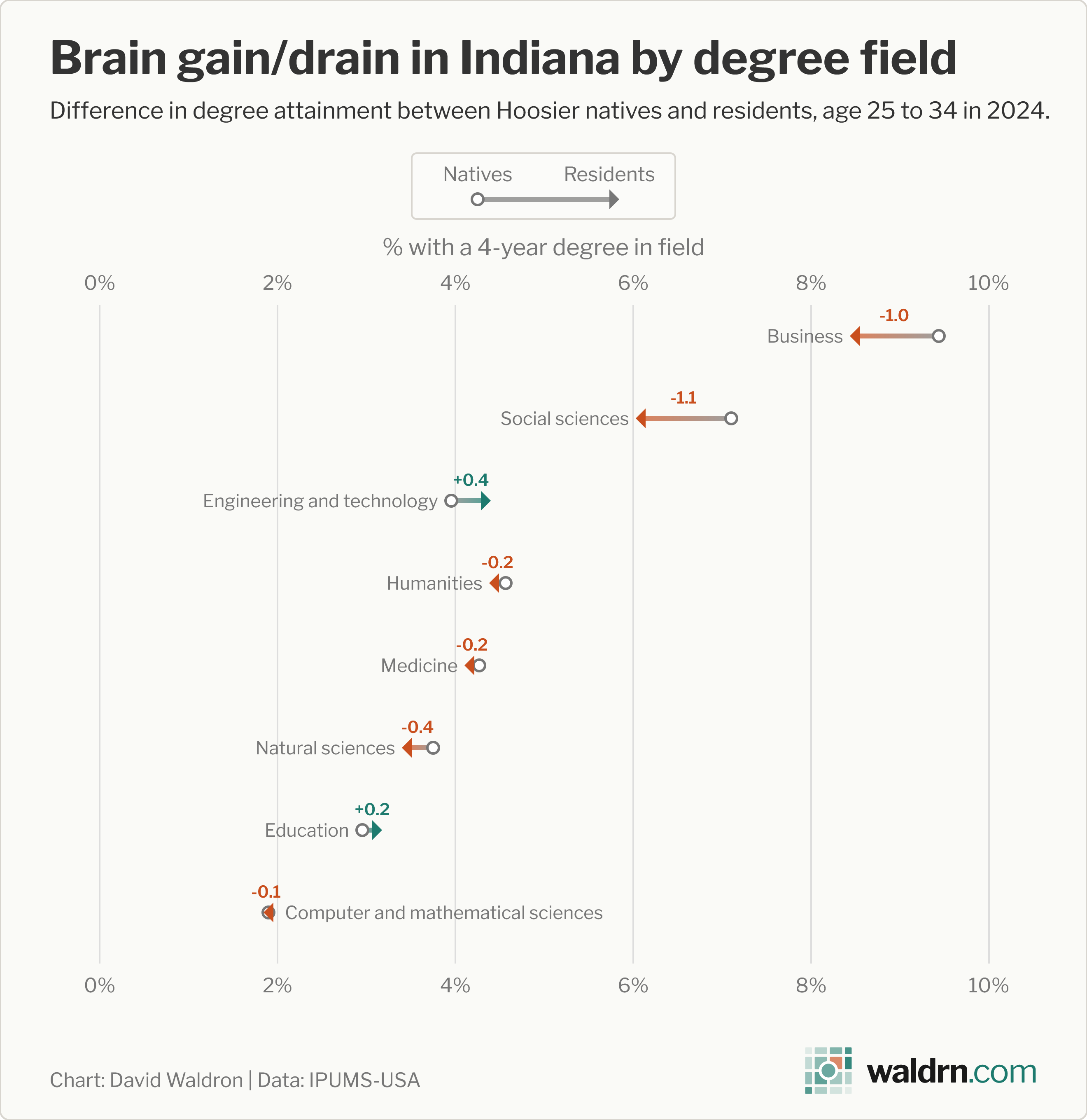
Crucially, net brain drain only reduces the college attainment of Indiana’s 25- to 34-year-old population by 2.2 percentage points, from 38% native attainment to 35.8% resident attainment. The bulk of this loss is in business and social sciences majors. Indiana actually gains a net 0.4 percentage points in engineering and technology majors, likely reflecting Purdue University’s ability to attract students with its highly-ranked engineering programs.
Not only is Indiana’s brain drain small, it has been roughly the same size for decades. In 1940, brain drain reduced college attainment of young adults by half a percentage point, from 6.6% to 6.1%. The net loss hovered around 2 percentage points for the next eight decades, even as college attainment rose from 6% to today’s 36%.
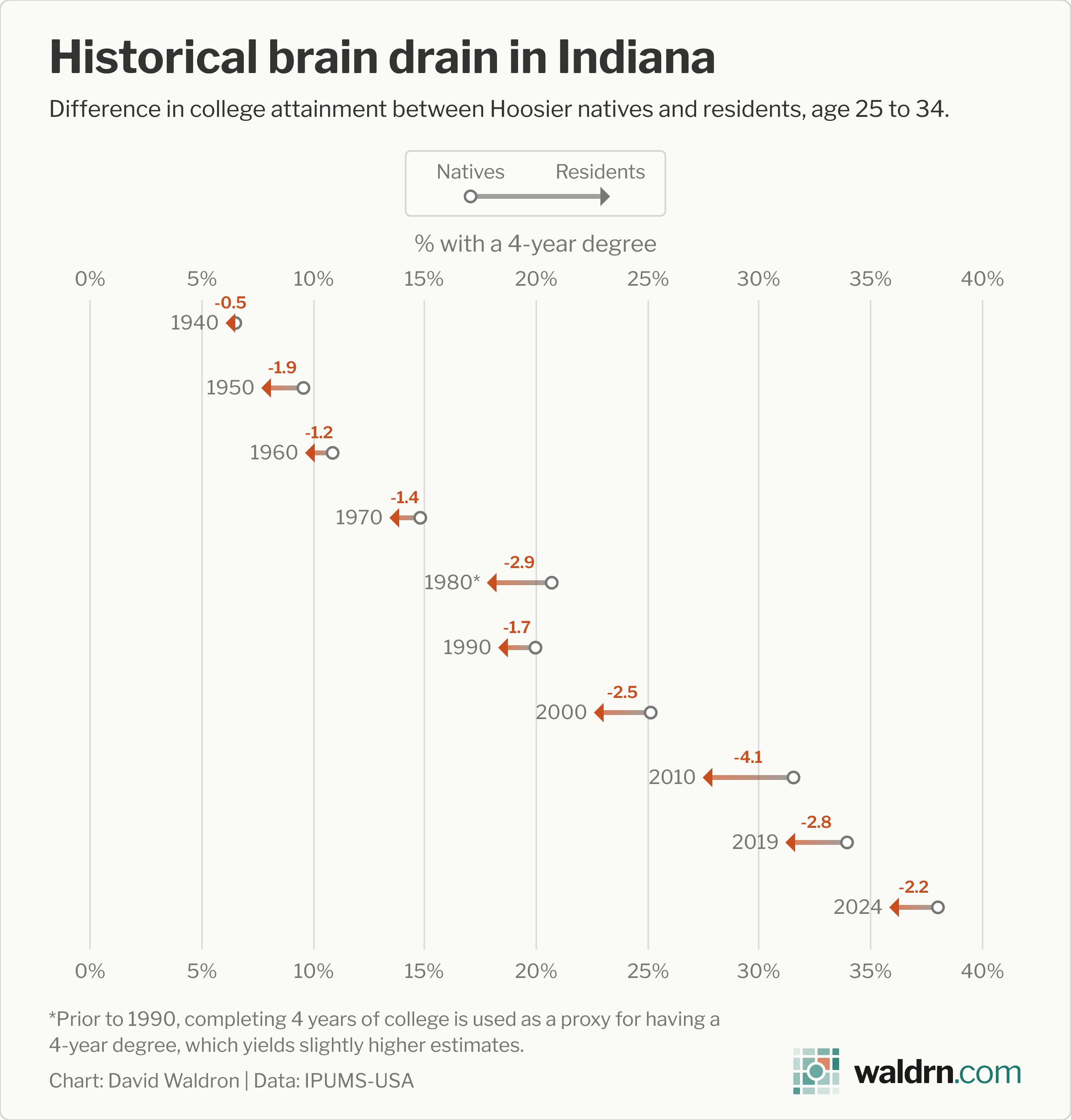
At this point, it should be clear that the main determinant of college attainment has not been the 2 percentage point loss from migration, but the 31 point increase in the percent of Indiana natives who earn college degrees. Brain drain is a small, background factor, not a driving force in the state’s college attainment rates.
A similar picture emerges when comparing all states in 2024. The native college attainment of 25- to 34-year-olds is highly correlated with the college attainment of current residents in that age group.
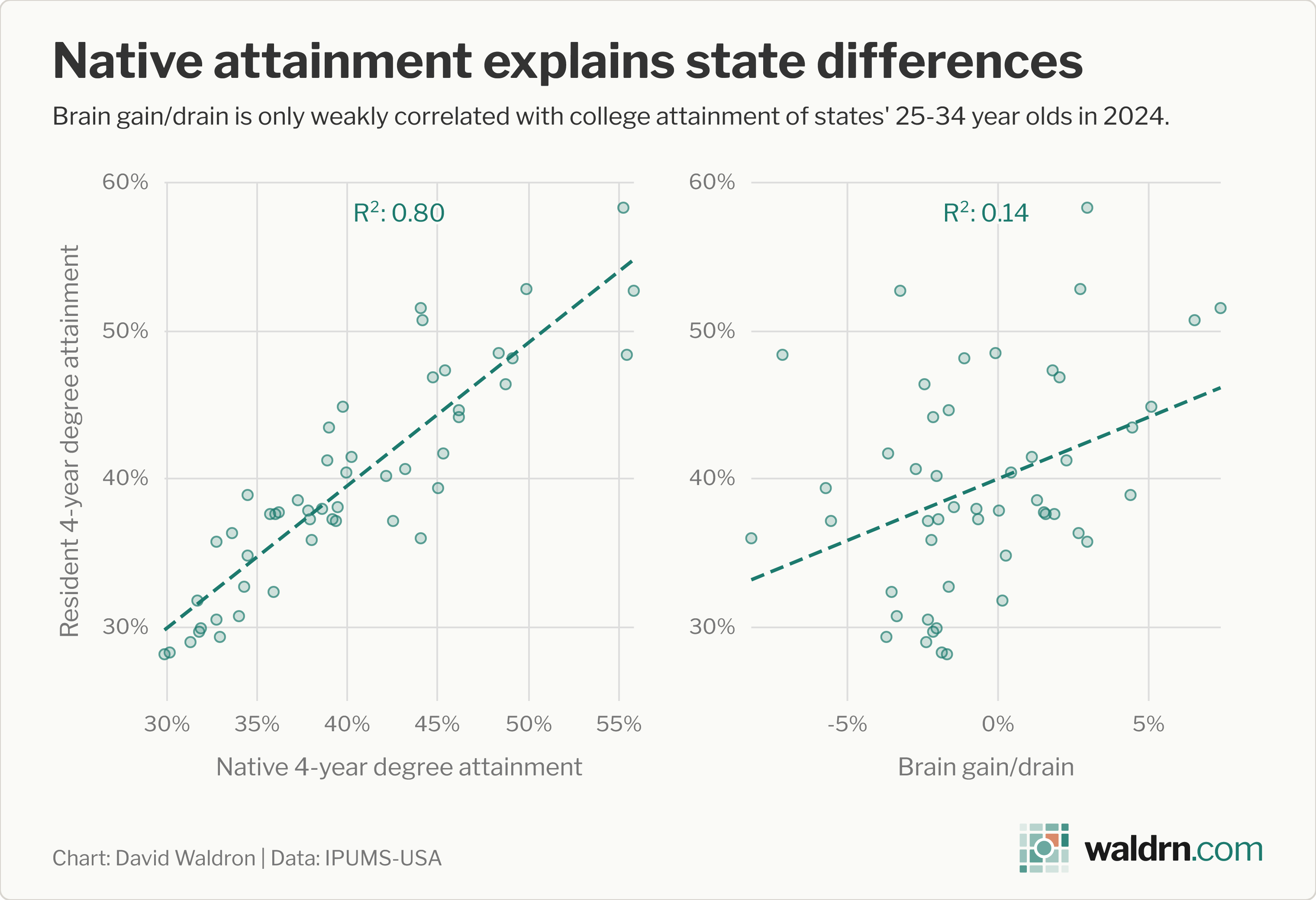
There is a weak association between brain gain and residents’ college attainment. States with brain gain tend to have slightly higher college attainment. Brain gain might contribute to these slightly higher college attainment levels. But the causal relationship might also run the other direction, as college graduates prefer to move to places with higher college attainment, in a self-reinforcing cycle known as agglomeration.
So what can Indiana do to increase the college attainment of its residents? The main lever to pull is to increase the share of native Hoosiers who will graduate from college. But that’s easy to say and hard to accomplish. And even more concerning, the state appears to be moving in the opposite direction.
In the past several decades, it has been possible to predict the native college attainment rate of young adults ten years into the future with one simple measure: the percent of native-born 19 to 21-year-olds who are enrolled in college3. Nationally, this rate has stagnated. In Indiana, it has been falling since 2011. In 2024, a 20-year-old born in Indiana was 35% less likely to be in college than a 20-year-old born in Massachusetts.
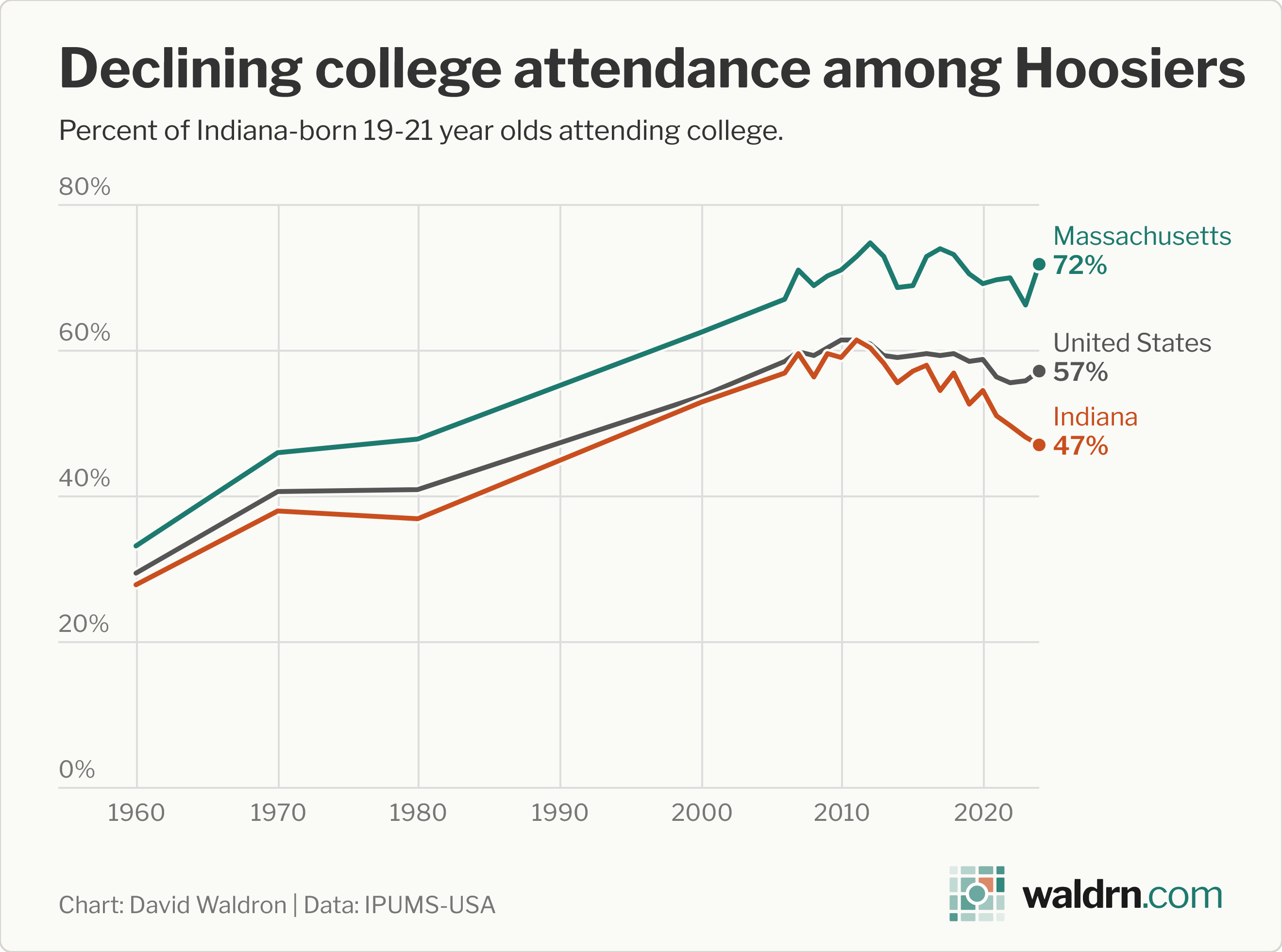
If past relationships hold, the 2024 college attendance rate for Indiana 19- to 21-year-olds predicts that the college attainment of Hoosier-born young adults will fall from 38% in 2024, to just 30% in 20344. Such a decline would be unprecedented and devastating for the state’s economic future.
The national stagnation in college attendance is largely a result of falling enrollment in 2-year institutions, which tends to be counter-cyclical (rising during recessions and falling during economic expansions) and has little effect on degree completions. But data from the National Center for Education Statistics suggests that Indiana’s falling college attendance rate is different from what is happening in other states. The percent of recent Hoosier high school graduates enrolling at 4-year institutions fell by 11.6 percentage points from 2010 to 20245. Enrollment at 2-year institutions fell too, but by a smaller 3.5 percentage points. This is starkly different from the national trend, where 2-year enrollment fell by 8.6 percentage points and 4-year enrollment has actually increased by 2.8 percentage points.
On top of these trends, Indiana has been enacting policies that push in the wrong direction. A redesign of high school diploma requirements emphasizes alternatives to college, potentially nudging students towards employment and work-based learning. While this focus will benefit some students, it is also likely to crowd out rigorous academics and college preparation for others. And to make matters worse, a major property tax overhaul has squeezed school budgets and sent districts scrambling to close the gap through referendums or by cutting services.
Recent declines in college-going in Indiana represent a serious threat to the state’s economic prosperity. This threat has very little to do with brain drain. Any serious attempt to strengthen Indiana’s college attainment rates will focus on substantially increasing the share of Hoosier children who go on to earn a college degree. This will require a renewed emphasis on academic rigor and college preparation from kindergarten through high school. Stable, robust funding for our K-12 schools is a long-term investment in our state’s future. When our leaders cut school funding sources as the state’s education numbers slide backwards, they are cashing in on our children’s future for quick political gain. In the Hoosier state, we call that eating our seed corn.
“College graduates” and “college attainment” in this post refer to graduates and attainment at the 4-year degree level.
This measure has the benefit of capturing the net migration during the period of time when people are most mobile (18-24). This captures both migration to college and migration after graduation. This is important because measures that only capture migration after graduation fail to account for the fact that high rates of graduate outflows tend to reflect high rates of students inflows to attend college. For example, retention of Purdue University engineering graduates is low because fewer of those graduates originated in the state to begin with.
One caveat to the birthplace measure is that it also captures moves during childhood. People tend to also have high geographic mobility in the first few years of life. So, if a state disproportionately loses college degree-bound infants and toddlers, that will also show up as brain drain in this measure.
This measure includes attendance at 2-year institutions. Note also that this is a more comprehensive measure than the oft-cited college-going rate, which only includes recent high school graduates in the denominator.
The model used here is a linear regression of state- and year-level college attainment of the native age 25-34 population on a 10 year lag of the college attendance rate of native age 19-21 population and a linear year trend. Years included are 1970, 1980, 1990, 2010, 2019 and 2024, based on the availability of the college attendance measure.
Data on enrollment of recent freshmen by state of residence are from the NCES Trend Generator. The denominator is the annual number of high school graduates, compiled by WICHE in its Knocking at the College Door reports.